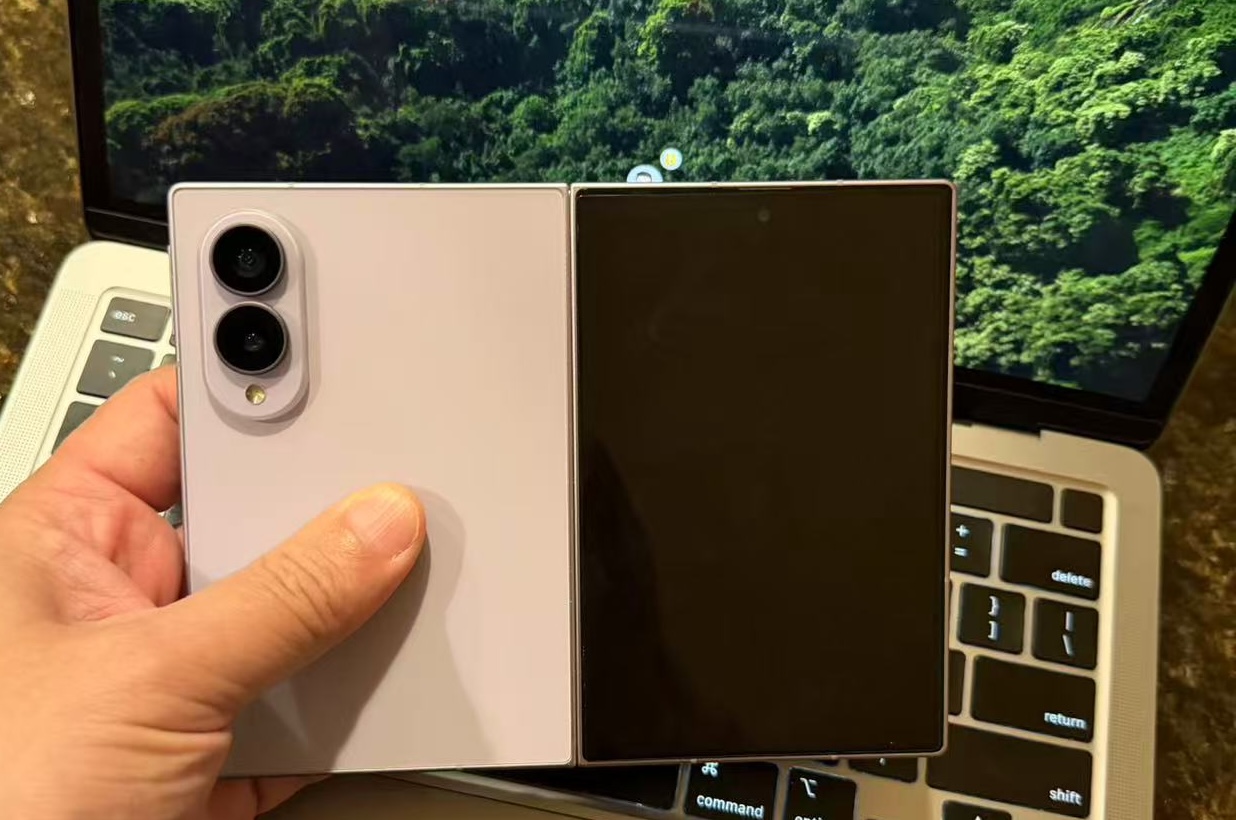
My Samsung Fold 8 showed up about a month ago. My carrier's trade-in program took my Fold 7 and handed me the $2000 next one at almost no cost — and I think that's a strong play by Samsung, working with carriers to seize the market early, before Apple moves. I've been folding my phone in half since the Fold 2, then the Fold 5. Three generations. But the Fold 8 is different: a passport ratio, a passport shape.
Then Apple announced the iPhone Duo last week — exactly the same size and ratio as the Fold 8. Funny that the screen supplier is Samsung.
The iPhone Duo will become the best-selling foldable phone in the world.
That's the tell. Every fold on earth is converging on the same object — Samsung, Huawei, Xiaomi, and now Apple, all arriving at a booklet the size of a travel document. When an entire category stops arguing about form factor and settles on one shape, the experiment is over. The hardware question is answered. And the moment a category's experiment ends is, historically, the exact moment Apple walks in the door.
It will do it despite being roughly the 8th company to the party. Samsung has been at this for 8 generations. Huawei and Xiaomi have shipped folds I'd argue are more daring than anything Cupertino just showed. None of that will matter. It never has.
Let's look back. Apple didn't make the first MP3 player, the first smartphone, the first smartwatch, the first wireless earbud, the first tablet. It was late to every one of them, sometimes embarrassingly late. And it now owns or defines most of those categories. This isn't luck, and it isn't a fluke you can dismiss twice. It's a strategy, held for two decades with extreme patience: let someone else be first, let them pay the tuition, then arrive last and be best.
Why will last win?
Apple does three things in my eyes.
The first is the boring one: supply chain. Folds are miserable engineering — a hinge that survives a quarter-million cycles, an OLED panel bent against itself every day, a thinness that fights the battery for every millimeter, a screen you fold toward the glare. Everyone in the category lives with some compromise here. Apple's advantage isn't a secret material; it's that when you are Apple, you set the quality bar and the world's best component makers reorganize their factories to clear it. Eight years of other people's failures become your spec sheet. You inherit every solved problem and pay for none of the mistakes.
The second is the one Samsung has always been trying to crack: software and ecosystem. A fold is only as good as the apps that know they're being folded — that reflow, split, and rearrange when the screen doubles. On Android, fold-aware apps have always lagged the hardware; the panel opens and half your apps just stretch and shrug. Apple ships the Duo with iOS rebuilt for the fold's new poses, and — this is the part that compounds — developers will chase those poses fast and thoroughly, because they always do for iOS. The hardware gap between the folds is now narrow. The software gap is where Apple wins, and it widens every quarter because of who's building for it.
The third is the one that makes the other two profitable. The Duo starts at $2,000 and climbs toward $3,000, and that price would drown almost any other product on the market. For Apple, it's not a liability; it's the point. A brand can become a social object — a thing you own partly so that other people watch you own it. Unfold a Duo at a café table, and you've said something. That's not engineering; it's what turns a brand into currency people spend on each other. Samsung and Xiaomi make superb hardware and confer none of it. Apple has done this for twenty years, and it's the reason a premium that should repel buyers will instead pull them in.
The honest part again
I've spent this whole post predicting Apple wins, so let me argue the other side, because I might be wrong about some of this.
The Duo is not the best fold on paper. It drops the telephoto lens. It ditches Face ID for Touch ID, and it's thicker and heavier than the Fold 8. If "best foldable" meant "best specifications," Apple would lose this outright, and it wouldn't be close.
But "best specs" has never been the game, and it has never been what moves the mass market at Apple's level. That's the whole thesis, and it's also the thing that could break it. Maybe the fold is different. Maybe a $2,000 phone-that-becomes-a-tablet is a genuinely harder sell than an earbud or a watch, and the price ceiling finally holds. Maybe eight generations of Samsung refinement plus a saturated Chinese market is a moat that even Apple's patience can't cross. Hard to say. But I've been folding phones since before it was fashionable, and the honest answer is that I'm predicting a repeat of history, not reporting a result.
So — is the foldable the category where Apple's never-first-but-best streak finally snaps? Or is my free Fold 8 just the last non-Apple fold I'll ever carry, a good phone I'll keep using right up until the café table makes the decision for me?